

Reading time: 7 min
"Law firms that ignore AI in 2026 are not playing it safe; they are falling behind. The real question is not whether to use AI, but whether you are using it the right way."
AI is no longer something legal teams can put off thinking about. It is already being used inside law firms and legal departments across Europe to review contracts, summarize case files, search through thousands of documents in minutes, and draft legal correspondence.
But here is the problem most firms are not talking about: the moment a lawyer uploads a client's file to an AI tool; they may be breaking the law.
Client confidentiality is the foundation of legal practice. And most AI tools on the market today are cloud-based meaning your client's sensitive data leaves your office, travels to a remote server somewhere, and gets processed by a system you do not control.
This guide explains everything legal teams need to know about AI in 2026 in plain language. What the key terms mean, what the rules say, how safe AI systems are built, and what your firm should do right now.
I. Before You Use AI: The Words You Need to Know
AI comes with a lot of technical language that can feel overwhelming. Here are the most important terms, explained in plain language.
Large Language Model (LLM): This is the type of AI that reads and writes text. It is what powers tools that summarize documents, answer legal questions, and draft contracts. Think of it as an extremely well-read assistant that has processed millions of pages of text and can respond intelligently to questions. The catch: it needs data to work with and in legal practice, that data is often confidential.
On-Premise AI: This means the AI runs on computers inside your own office or building. Nothing is sent to the internet. Your client's data never leaves your control. For legal teams, this is the gold standard and, in many cases, the only option that is legally safe.
Air-Gapped System: This goes one step further than on-premise. An air-gapped system is completely cut off from the internet; it cannot send or receive data from outside. It is the most secure option available, used in environments where data leaks would be catastrophic. For firms handling criminal cases or highly sensitive matters, this is worth considering seriously.
RAG (Retrieval-Augmented Generation): Do not let the name put you off. RAG simply means the AI searches through your own documents to find answers, rather than relying on general knowledge. So instead of the AI guessing, it reads your actual case files, contracts, or legal library and gives you answers based on that specific material. It is more accurate and far more useful for legal work.
Hallucination: This is one of the biggest risks with AI in legal work. Hallucination is when an AI confidently gives you information that is simply wrong. A made-up court case, a law that does not exist, a contract clause that was never there. It sounds real, but it is not. Any legal team using AI must always verify AI-generated content before relying on it.
Vector Database: The technology that makes RAG work. It stores your documents in a way that lets the AI search by meaning, not just by keywords. So, if you ask "what are the payment terms in this contract?", it finds the right section even if those exact words do not appear. You do not need to understand how it works just know that it makes AI significantly more useful for legal document work.
II. What the Rules Say
Legal professionals work in one of the most regulated environments in Europe. Here is what the current rules actually require when it comes to AI.
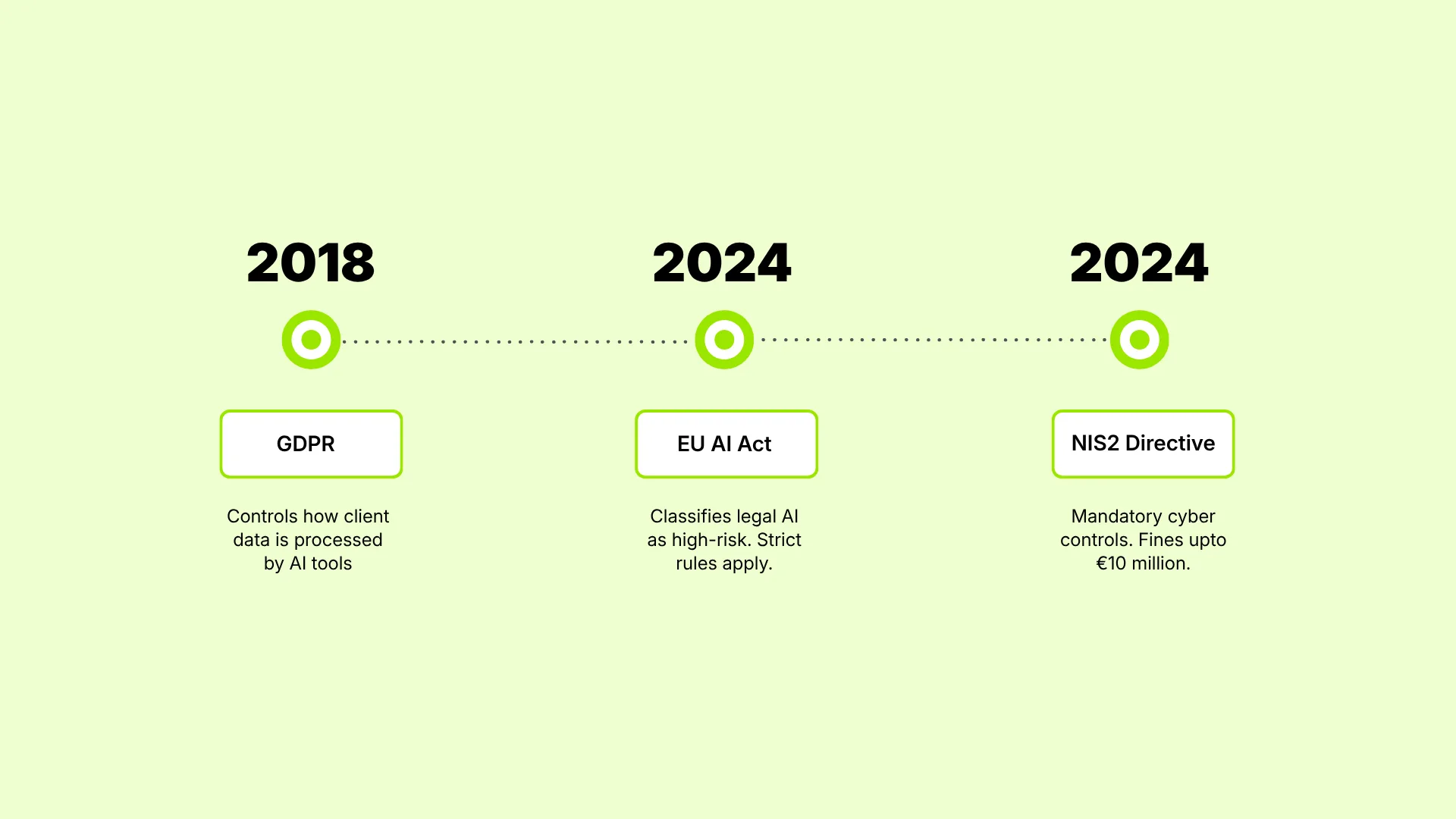
GDPR (The Data Protection Law): The General Data Protection Regulation sets strict rules on how personal data is handled. Article 9 specifically covers sensitive data including anything related to criminal cases, health, or legal proceedings. The rule is clear: you cannot send this kind of data to a third-party platform without a solid legal reason to do so. For most law firms using cloud AI tools, that legal reason simply does not exist. This means many firms are already breaking GDPR without realizing it.
The EU AI Act: The EU AI Act came into force in 2024 and is now being enforced across Europe. It puts AI used in legal work, contract review, case analysis, legal research, into the "high risk" category. That means the AI tools your firm uses must meet specific requirements: they must be transparent about how they work, they must allow human oversight, and they must be properly documented. If your AI vendor cannot show you this documentation, that is a red flag.
Professional Secrecy: Every lawyer in Europe is bound by professional secrecy, the obligation to keep client information strictly confidential. In Germany, this is written into § 43a of the Federal Lawyers' Act (BRAO). The rule applies regardless of what technology you use. Sending client data to a cloud AI platform, even a reputable one, may breach this obligation unless your client has given clear, informed consent.
NIS2 (The Cybersecurity Law): The NIS2 Directive became enforceable in October 2024. It requires law firms that handle sensitive work to have strong cybersecurity measures in place including controls over any third-party software or AI tools they use. Fines for non-compliance can reach €10 million. Most law firms are not yet fully compliant.
BSI IT-Grundschutz: For firms working with German public sector clients or government agencies, the BSI IT-Grundschutz framework sets the security standard. In practice, this means AI systems handling sensitive legal data must run on-premise or air-gapped not in the cloud.
III. How Safe Legal AI Actually Works
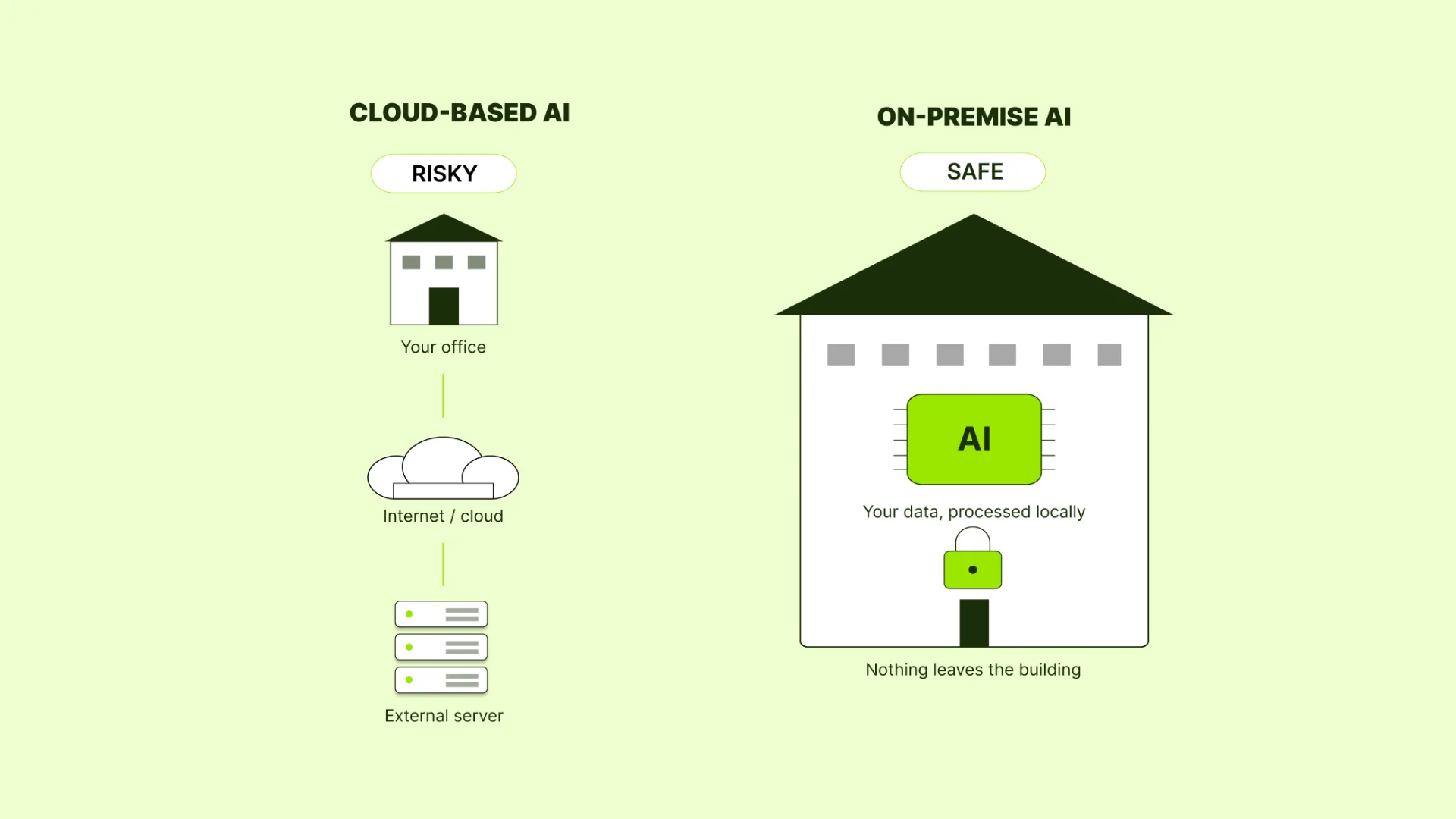
The difference between a safe AI setup and a risky one comes down to one question: where does the data go?
Cloud AI (The Risky Option): Most popular AI tools work in the cloud. You type something in, it goes to a server far away, gets processed, and the answer comes back. This is fast and convenient. But for legal work involving client data, it is not safe. The data leaves your control the moment you send it. Even if the vendor has strong security, you have no way to guarantee what happens to that data on their end.
On-Premise AI (The Safe Option): With on-premise AI, everything stays inside your building. The AI model runs on your own computers. Client data never travels anywhere. This is the only way to genuinely guarantee confidentiality, meet GDPR requirements, and honor your professional secrecy obligations.
The Hybrid Approach: Some firms use a mix: cloud AI for low-risk tasks like scheduling, billing, or researching publicly available case law and on-premise AI for anything involving client data. This works well, but only if you have a very clear policy about which data goes where. One accidental upload of a confidential file to a cloud tool is all it takes to create a serious problem.
How Sinabis Approaches This: Sinabis's Sinabox is built specifically for environments where data security is not negotiable. It is a self-contained unit, hardware and software together, that runs entirely offline. Legal teams get the full power of AI-assisted document analysis, case management, and search, without any data ever leaving their network. It is designed to meet GDPR, the EU AI Act, and BSI requirements out of the box.
IV. Who Is Responsible for What
Your Law Firm: You are responsible for making sure any AI tool you use complies with GDPR, professional secrecy rules, and the EU AI Act. Saying "the vendor told us it was compliant" is not a defense. You need to verify this yourself, get it in writing, and document your due diligence.
Your AI Vendor: Under the EU AI Act, vendors selling high-risk AI to legal teams must provide clear technical documentation and proof of compliance. If they cannot or will not provide this, do not sign a contract with them.
Bar Associations: The Council of Bars and Law Societies of Europe (CCBE) published its first guidelines on AI in legal practice in 2024. The message is straightforward: professional obligations apply regardless of the technology used. Ignorance of the technology is not an excuse.
Data Protection Authorities: The German Federal Commissioner for Data Protection (BfDI) and equivalent authorities in every EU member state have the power to investigate and fine law firms for GDPR violations. Several investigations into law firms using cloud AI without proper legal basis are already underway in Europe.
V. What Your Firm Should Do This Week
You do not need to change everything overnight. Start with these steps:
Find out what AI tools your team is already using: Many lawyers are already using AI tools often without formal approval. Do a quick audit. Ask your team. You may be surprised what you find.
Separate your data by sensitivity: Public legal research and administrative tasks can safely use cloud AI. Anything involving client data, case files, or privileged communications cannot. Draw a clear line and make sure everyone knows where it is.
Ask your AI vendors the hard questions: Request their EU AI Act compliance documentation. Ask specifically: where is our data processed? Who has access to it? What happens if there is a breach? If they cannot answer clearly, that tells you everything you need to know.
Move client data to an on-premise solution: This is the most important step. For any AI use involving real client files, you need a system that runs inside your own network. This is not optional; it is what the law requires.
Train your people: The biggest risk in most firms is not the technology. It is a well-meaning lawyer who pastes a client's email into AI because it is faster. Make sure your team understands why this matters and what the rules are.
Before You Close This Page
AI will make your legal team faster, sharper, and better at serving clients. But only if you use it correctly. The firms that will lead in 2026 are not the ones moving fastest, they are the ones moving most carefully. GDPR, professional secrecy, and the EU AI Act are not obstacles. They are the framework that keeps your clients and your firm protected.
For more information about Sinabis's secure AI and forensic solutions for legal teams, feel free to get in touch:
https://www.sinabis.com/contact/
Explore more from Sinabis GmbH:
Sources: GDPR · EU AI Act · NIS2 Directive · BSI IT-Grundschutz · CCBE · BfDI